


Faiths
working group

The Faiths Working Group brings people together from all religious traditions and spiritual backgrounds to turn personal faith into a powerful force for social justice. Inspired by the legacy of legendary civil rights organiser Ella Baker, we believe that true faith does not sit on the side-lines, it actively works to build a fairer, more equitable society.
We live in a world facing deep
systemic injustices, from poverty to inequality. While our theological traditions, rituals, and texts may differ, our core moral callings are the same: to love our neighbours, protect the vulnerable, and stand up against injustice. The Faiths Working Group is the bridge that connects these diverse spiritual roots to practical, strategic grassroots activism.

The Ella Baker School of Organising’s Faiths Working Group comprises people from diverse faiths and backgrounds. People of all faiths who are committed to social justice, are welcome to join. The faiths currently represented are:
Bahai Christian Hindu Jewish Muslim Sikh


why a faiths working group?
As a group that believes in justice and human rights we fully support the provisions in the Equality Act. Religion or Belief is one of the protected characteristics that the Equality Act 2010 seeks to protect from discrimination. However, in our experience, some people who are happy to support anti-discrimination law to protect people on other grounds, can be uncomfortable with the idea that discrimination on the basis of faith is comparable.


© the copyright holder. Image credit: People's History Museum
Find out more here: www.tolpuddlemartyrs.org.uk/story
Some people mistakenly associate faith with the difficult behaviours of high-profile people who profess faith but act differently. There are plenty of examples, from Mary Whitehouse, to the Reverend Ian Paisley, of people whose manipulation of faith teaching ends up as a tool to oppress others. Equally, authoritarian populist politicians often try to wrap their divisive politics in faith identities, including the co-option of Christianity in the USA, Hinduism in India, Islam in Afghanistan, Judaism in Israel. We will not accept the redefining of faith by those who seek to use faith as cover for policies that oppress others. We will celebrate the amazing contributions of people of faith to the advancement of social justice.
There is a rich history of people of faith advancing social justice, whether that be the Methodist inspired Tolpuddle Martyrs, the Quaker inspired abolitionists, the Christians who worked so hard both here and in South Africa, to hasten the end of Apartheid, the liberation theology that emerged in central America during the 1960s, or the contributions of people of Christian, Jewish and Muslim faiths to the African American Freedom struggles (we will never forget the contributions of James Chaney, Andrew Goodman, and Michael Schwerner, who were murdered while undertaking voter registration in the deep south, in June 1964).

Rev. M. L. King Jr. and Rabbi A. J. Heschel in Alabama in 1965, enshrining the Grand Alliance between Black and Jewish Americans
“We need more light about each other. Light creates understanding, understanding creates love, love creates patience, and patience creates unity.” - Malcom X

The myth that people of faith are somehow an obstacle to social progress ignores both the reality of the contribution of people of faith, and the core teachings of all major faiths, a teaching that there is an obligation to care for those around us. This myth is just one more narrative of division and it is used to divide us. Our struggles for justice for all, have always been enriched by people of faith.


why a faiths working group?
Rev. M. L. King Jr. and Rabbi A. J. Heschel in Alabama in 1965, enshrining the Grand Alliance between Black and Jewish Americans
“We need more light about each other. Light creates understanding, understanding creates love, love creates patience, and patience creates unity.” - Malcom X
There is a rich history of people of faith advancing social justice, Whether that be the Methodist inspired Tolpuddle Martyrs, the Quaker inspired abolitionists, the Christians who worked so hard both here and in South Africa, to hasten the end of Apartheid, the liberation theology that emerged in central America during the 1960s, or the contributions of people of Christian, Jewish and Muslim faiths to the African American Freedom struggles (we will never forget the contributions of James Chaney, Andrew Goodman, and Michael Schwerner, who were murdered while undertaking voter registration in the deep south, in June 1964).
Some people mistakenly associate faith with the difficult behaviours of high-profile people who profess faith but act differently. There are plenty of examples, from Mary Whitehouse, to the Reverend Ian Paisley, of people whose manipulation of faith teaching ends up as a tool to oppress others. Equally, authoritarian populist politicians often try to wrap their divisive politics in faith identities, including the co-option of Christianity in the USA, Hinduism in India, Islam in Afghanistan, Judaism in Israel. We will not accept the redefining of faith by those who seek to use faith as cover for policies that oppress others. We will celebrate the amazing contributions of people of faith to the advancement of social justice.
© the copyright holder. Image credit: People's History Museum
Find out more here: www.tolpuddlemartyrs.org.uk/story
Our struggles for justice for all, have always been enriched by people of faith.
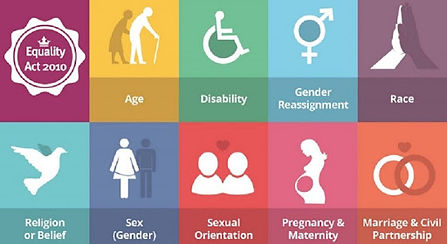
Religion or Belief is also one of the protected characteristics that the Equality Act 2010 seeks to protect from discrimination. As a group that believes in justice and human rights we fully support the provisions in the Equality Act. However, in our experience, some people who are happy to support anti-discrimination law to protect people on other grounds, can be uncomfortable with the idea that discrimination on the basis of faith and belief is comparable.
This working group is one piece of the jigsaw which allows the Ella Baker School of Organising to state that when people work with us, they can proudly bring their whole identity to the work.
the working group's journey

Some of the members getting together to put the final touches on the plan for the first ever 'faith in the workplace' session, at the 2023 New Organising Conference.
Little did they know, that with the rest of the team, they would soon form the Faiths Working Group, and produce their very own charter.
The first 'Faith at Work' session underway. Bringing organisers and activists together from across the country and beyond, to celebrate strengths, explore collective challenges, and discuss what needs to be done.


With great connections forged, a group of dedicated organisers continued to meet throughout the year, inviting others to join along the way - growing the community, developing ideas and approaches, and producing the Faith at Work Charter, to support workers of all faiths and beliefs in the workplace.
This picture was taken with just some of the Working Group members on the day that the charter was first written.

Taking us up to the summer of 2024, when the Faith at Work Charter was launched at the second annual New Organising Conference.
From 2024 forward, the Faith at Work Charter became a springboard which led us to formalise as a group, and widen our scope.
Our aim is to bring together people from all religions, beliefs and backgrounds to use their personal faith as an inspiration and powerful force that drives them to work towards social justice. We want to create a society where we have peace, justice, diversity of friendships and genuine respect for everyone.
If you are a person of faith and are interested in knowing more or even interested in joining us, email: mahmooda@ellabakerorganising.org.uk

faith at work
It is important that all employers accommodate their workforce in making them as comfortable as possible, so they can bring their whole self to work, but may not necessarily know where to start.
The Ella Baker School of Organising’s Faiths Working Group delivered several sessions on organising and faith in the workplace at the 2023 and 2024 New Organising Conferences. Building on that work, we have gathered resources, from multiple platforms and people of faith, to support ourselves and others with 'faith in the workplace' organising. The Faith at Work Charter was launched at the New Organising Conference in Nottingham University on the weekend of 6th July 2024.
Please feel free to access these resources to support your work:
why faith?
‘It is better to light a candle than curse the darkness’ - Eleanor Roosevelt


Faith plays a significant role in many people's lives, offering a sense of purpose, motivation, direction, clarity and comfort, particularly in times of uncertainty or hardship. Religion provides individuals with a framework for understanding the world, coping with life's challenges, and building a sense of community through shared beliefs and practices.
Faith and belief can be such a fundamental part of how people understand and operate both within the world, and within themselves, that it's important that people of faith are welcome to bring their whole selves into their homes, neighbourhoods, organising spaces and their work. To not be, is to the detriment, both of those individuals, and of the communities and workplaces who won't therefore benefit from all that person can bring.


